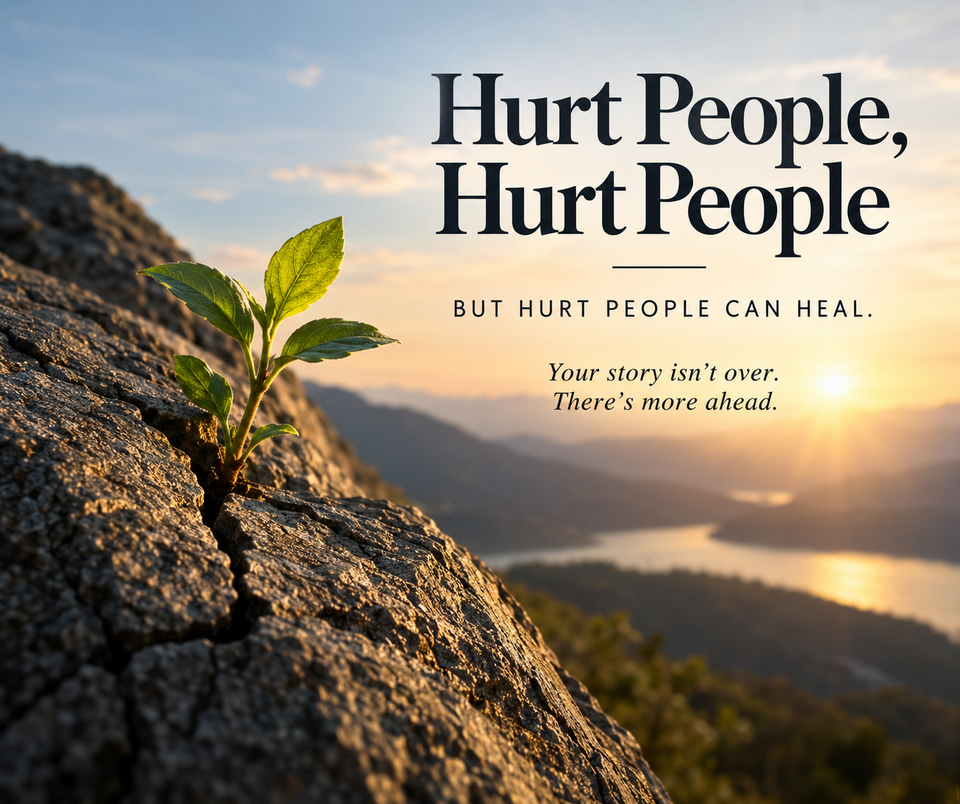
Hurt People, Hurt People
There is an old saying that gets repeated whenever someone makes a hurtful choice:
Hurt people hurt people.
It's usually meant to remind us that there may be more behind someone's behavior than what we can see. Anger may have a history. Bitterness may have a beginning. The person who seems impossible to get along with may be fighting something we know nothing about.
But I think there is another side to that saying.
Yes, hurt people sometimes hurt people. But hurt people can also heal. They can grow. They can forgive. They can learn healthier ways to respond. They can allow God to take the places where they have been wounded and transform them into places of compassion.
Eventually, the very thing that once threatened to define them can become part of their testimony.
But first, sometimes we have to learn to look beneath the surface.
What You Can't See
I began my career in education as an instructional aide at a school for students with severe behavior disorders. I didn't know it at the time, but that job would eventually change the direction of my life.
Some of the behaviors were extreme. Desks were thrown. Students spit, fought, screamed, and used words that nobody should hear—much less repeat.
It would have been easy to look at those choices and define the child by their behavior.
But that wasn't what I saw.
I saw a child of God.
I saw a whole child fighting an internal battle that most people couldn't see. Somewhere underneath the anger and aggression was often a kid who was hurting. A kid who needed someone to believe in them. Someone who would show up tomorrow even after today had been terrible.
They needed consistency.
That became especially clear when they pushed against boundaries. At first, it could look like simple defiance. Set a limit and they immediately tested it. Hold the line and they pushed harder.
But eventually I began to understand something: sometimes they weren't testing the boundary because they wanted it gone. They were testing it to find out if it would stay.
When so much in your life has been temporary, consistency can be difficult to trust. So they pushed.
Are you still going to be here if I do this? Does this boundary still exist when I'm angry? Do you still care about me when I'm difficult to love?
That experience eventually helped lead me to become an Education Specialist. I had been on a path toward working in ministry, but God began showing me that perhaps I was already standing in the ministry He had for me.
Sometimes ministry looks like standing in front of a room teaching Scripture. And sometimes it looks like looking beyond a child's behavior long enough to see the child.
The Iceberg
The people we come in contact with every day are no different. We usually encounter what is above the waterline.
Someone snaps at us. Someone is rude. Someone becomes defensive. A family member shuts us out. A coworker seems angry at the world. Someone says something that hurts us, and our natural reaction is to respond to what we can see.
But an iceberg doesn't end at the waterline.
What we see above the surface may be anger, defensiveness, control, withdrawal, distrust, or bitterness. Underneath may be grief, rejection, abandonment, betrayal, fear, trauma, shame, a childhood that never felt safe, a relationship that left scars, or a loss nobody knows they're still carrying.
We simply don't know what's beneath the surface.
Instead of immediately asking, What's wrong with them?, perhaps sometimes we should ask: I wonder what has happened in their life that makes them respond this way.
That doesn't mean allowing someone to mistreat us. Compassion doesn't eliminate boundaries, and understanding someone's wounds doesn't excuse the wounds they inflict on others. But it can change the posture of our heart toward them.
There's an old expression: “Kill them with kindness.” Maybe there's more biblical truth buried in that phrase than we realize—not because kindness is a weapon, but because love refuses to let someone else's hurt determine who we become.
Peter writes that love “covers over a multitude of sins” (1 Peter 4:8). Jesus takes us even further, telling us to love our enemies and pray for those who persecute us (Matthew 5:44).
That's difficult Christianity.
It's easy to love people who treat us well. It's much harder to look at someone who has hurt us and remember that we may be seeing only the tip of their iceberg.
We see the behavior. God sees the whole person.
Following Jesus may mean learning to look a little deeper too.
But What About My Iceberg?
There's another side to this. It's considerably easier to look beneath someone else's behavior than it is to examine our own.
We can recognize their anger, their bitterness, their need for control, their defensiveness. We can probably even identify exactly what they need to work on.
Looking below our own waterline is harder.
Maybe my anger has something underneath it. Maybe my need to control everything isn't simply part of my personality. Maybe the reason I withdraw whenever conflict begins has a history. Maybe I'm making people who never hurt me pay for wounds they didn't create.
Compassion asks us to consider what might be underneath someone else's behavior. Growth requires us to have the courage to look underneath our own.
Our wounds may explain some of our behavior. They may help us understand why certain situations trigger us or why we respond in ways we wish we didn't. But eventually we have to make a choice.
My wounds may explain my behavior. They don't give me permission to keep wounding other people.
When the Wound Becomes Your Identity
Some people really are victims. Terrible things happen to people that they didn't cause, didn't deserve, and couldn't control. Abuse is real. Betrayal is real. Trauma is real. People can make choices that leave wounds in someone else's life for years.
Acknowledging that isn't a victim mentality.
The danger comes when “This happened to me” slowly becomes “This is who I am.”
Then everything begins to pass through the wound: They did this to me. That's why I'm this way. I can't change because of what happened. My life would be different if they hadn't...
Some of those statements may contain quite a bit of truth. But there is a danger in building our identity around them. Eventually the person who hurt us can continue exercising influence over our lives long after they're gone.
They may have caused the wound. They don't have to determine what grows around it.
At some point, healing requires us to stop asking only what someone else did to us and begin asking what we are going to do with what remains.
What Can Grow Here?
We hear a lot about having a growth mindset. At its simplest, a growth mindset is the belief that where I am today doesn't have to be where I remain tomorrow.
I can learn. I can change. I can heal. I can develop healthier patterns. I can ask for help. I can become more than what happened to me.
For the Christian, though, there is another dimension to this. We're not simply trying to become stronger versions of ourselves. We are allowing God to transform us.
Paul writes in Romans 12:2 about being transformed by the renewing of our minds. Transformation means something changes. Old patterns don't have to remain permanent simply because they've been there a long time.
That doesn't mean healing happens quickly. Some wounds are deep. Some require counseling, medical care, trusted relationships, boundaries, time, prayer, and a lot of work.
Growth isn't pretending you're fine. Sometimes growth begins by finally admitting that you're not. It isn't denying what happened. It's deciding that what happened doesn't get unlimited authority over what happens next.
Instead of asking only, Why did this happen to me?, eventually we can begin asking:
God, what can You do in me from here?
You Meant It for Harm
Few biblical stories demonstrate this better than Joseph.
Joseph was one of twelve brothers, and his brothers hated him. Their jealousy eventually grew so strong that they threw him into a pit and sold him to traders headed for Egypt. Then they went home and allowed their father to believe Joseph was dead.
Joseph's life changed because of choices other people made.
In Egypt, he was sold as a slave. Later, he was falsely accused of something he didn't do and thrown into prison. Years passed. One painful chapter seemed to lead directly into another.
But Joseph's story didn't end in the pit, in slavery, or in prison.
God continued working through his circumstances. Eventually Joseph rose from being a prisoner to becoming one of the most powerful leaders in Egypt. When a severe famine struck the region, Joseph was placed in a position to preserve countless lives.
Eventually, the same brothers who had sold him came to Egypt looking for food.
Imagine that moment. The people responsible for so much of Joseph's suffering were suddenly standing in front of him—and now he had the power.
He could have used that power for revenge. Instead, Joseph eventually told them:
“You intended to harm me, but God intended it for good.”
— Genesis 50:20
You intended harm.
Joseph knew exactly what his brothers had done to him. But he could also look back over his life and see something they could not have anticipated: God had been at work through all of it.
The pit hadn't been the end of his story. Neither had slavery. Neither had prison. What his brothers intended to destroy him became part of the path God used to position him to save others.
Their intentions did not determine God's outcome.
Joseph's brothers had written a painful chapter in his life. They didn't get to write the ending.
Neither does the person who hurt you.
The Enemy Would Love to Keep You There
There is a spiritual battle in this too.
Satan would love nothing more than for us to spend the rest of our lives trapped in what happened to us—replaying the betrayal, rehearsing the offense, returning to the moment everything changed, blaming today's choices entirely on yesterday's wounds, and waiting for someone else to fix what they broke.
Because if the enemy can keep our eyes permanently fixed on the wound, he may never need to create another one.
The first wound happened once. Bitterness can make us relive it for years.
That doesn't mean we simply decide one morning to “get over it.” Deep wounds don't disappear because somebody quotes a Bible verse at us.
But we can decide who gets authority over what comes next: the person who hurt us, the wound itself, or Jesus?
Look at His Scars
After the resurrection, Jesus still had scars.
The wounds of the cross remained, but their meaning had changed. What had once marked suffering and death now testified to resurrection and victory.
The scars remained. The defeat didn't.
Maybe that's a better way to think about our own scars.
Healing doesn't require erasing our past. The betrayal, abuse, loss, or rejection may always be part of our story, but it doesn't have to determine where the story goes next.
Our scars can remind us where we've been while our lives testify to what God has done since.
From Victim to Victorious
Maybe you really were a victim. Maybe someone did something to you that never should have happened. Maybe you lost something you can never get back. Maybe there are parts of your story you wish you could erase.
You don't have to pretend otherwise. But you also don't have to build your home there.
The enemy would love to make your wound your identity. Jesus wants to make it part of your testimony.
Maybe your pain gives you compassion for someone walking through the same thing. Maybe your recovery allows you to sit beside someone who thinks they'll never recover. Maybe the place where you once felt completely alone becomes the place where you recognize someone else's loneliness.
And maybe someday someone looks at you and asks, How did you make it through that?
Suddenly, the chapter you wished had never been written becomes an opportunity to point toward the One who carried you through it.
That's testimony.
Not pretending the wound never happened or claiming everything has been perfectly restored, but being able to look at a scar and say:
That happened to me. But it doesn't own me anymore.
Hurt People Can Heal
So perhaps the saying needs another line:
Hurt people hurt people. But hurt people can heal.
They can become compassionate people. Forgiving people. People who recognize pain in someone else because they know what pain looks like.
So when someone hurts you, remember the iceberg. You may not know what's happening beneath the surface. Show compassion where you can. Maintain boundaries where you need to. Remember that God sees the whole person even when you can see only the behavior.
Then have the courage to look beneath your own waterline.
Don't allow your wounds to become excuses for wounds you create in others. Get help when you need it. Do the work. Forgive. Grow. Let God into the places you'd rather keep hidden.
And don't surrender the rest of your story to someone who only participated in a chapter of it.
You may have been a victim of what happened. You don't have to remain a prisoner of it.
Satan would love to keep you trapped in the struggle of what happened to you—focused on your wounds and allowing yesterday's pain to determine tomorrow's life.
Jesus offers something different: victory.
Not because the wounds weren't real, but because they don't have to own what comes next.
Let God take what the enemy would use to keep you trapped and turn it into testimony. Let your life point toward what Christ has done rather than remain defined by what someone else did.
Your wound can be part of your story without becoming your identity.
You don't get to choose every chapter that gets written in your life. But you can choose who you trust with the ending.
And maybe today, that's your one step forward.
Take Your Next Step
Looking for more encouragement as you grow in your faith?
Explore the One Step Forward Resource Library, where you'll find free and affordable Bible studies designed to help you draw closer to God and apply His Word to everyday life.