
Hairline Fracture
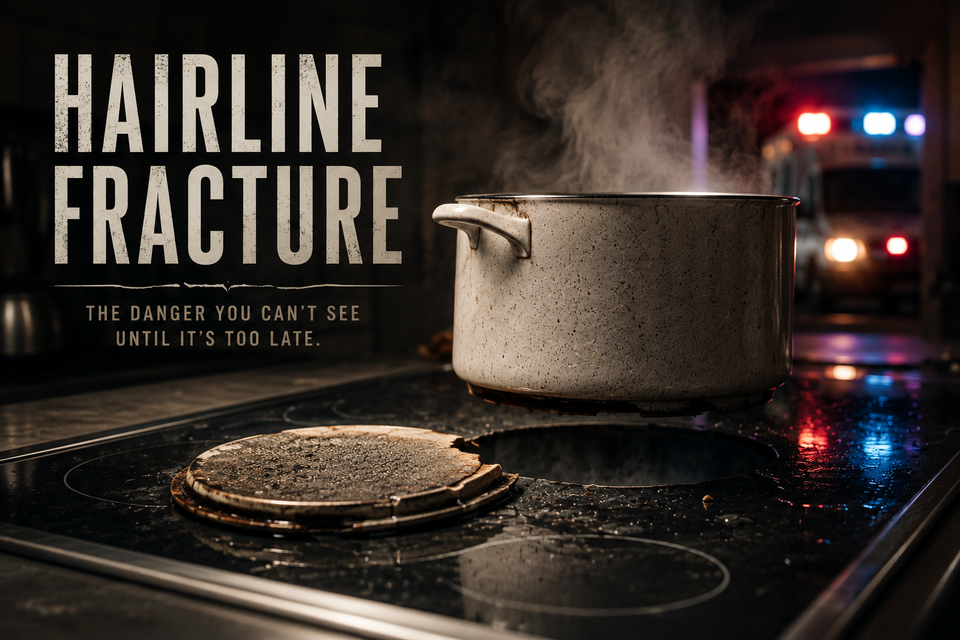

A few years ago, we were in the middle of the normal chaos of getting everyone ready for school. Our three boys were sitting at the breakfast bar eating while I was making breakfast on the cooktop directly in front of them. Our youngest came around into the kitchen and I perched him up on the countertop on the other side of me, so he could “help” me cook—which, if you've ever cooked with a small child, usually means doing the same job with an additional person touching everything.
I had filled a Dutch oven with water to hard-boil some eggs. The kids were talking, breakfast was happening, and the water had come to a boil. Then one of my boys noticed something strange. “Dad, there's water under the pot.” I looked over and saw water dripping onto the stove. That's weird.
I grabbed a couple of potholders and lifted the Dutch oven to see where the water was coming from. The moment I picked it up, the entire bottom of the pot fell off.
Boiling water poured across the countertop and directly onto the legs of the boys sitting on the other side and the youngest positioned right next to me on the counter. Everything changed instantly. There was screaming. Chairs moved. Laura and I rushed toward the kids, trying to figure out who had been burned and how badly. Within seconds we realized just how bad it was. Before long there were paramedics, an ambulance, and eventually a trip to the burn unit at Community Regional Medical Center.
The burns were bad. The trauma may have been worse. Thankfully, with time, everyone healed with minimal scarring. But afterward, when the panic had passed and I had time to think about what happened, one question kept bothering me: How does the bottom just fall out of a Dutch oven?
We eventually found the answer. There had been a hairline fracture.
It Was Already Cracked
The pot looked fine. I hadn't knowingly filled a broken pot with water that morning. It sat on the stove exactly like it had before. It held the water. Nothing about it warned me that a few moments later we would be rushing our children to the hospital in an ambulance.
But somewhere in the structure was a weakness—a crack small enough to go unnoticed, but significant enough to compromise the integrity of the entire pot. Then came the heat. The water began to boil. Pressure worked against the weakness until eventually the crack could no longer hold, and the bottom fell out.
I've thought about that pot many times since then because I think people can be a lot like it. Most collapses don't begin with the collapse. They begin with a crack.
The Cracks We Ignore
We usually notice the explosion. The affair is discovered. The marriage falls apart. The addiction becomes impossible to hide. Anger finally erupts. The financial mess comes into the open. A relationship is destroyed. Everyone asks, How did this happen?
But often, something had been happening for a long time. The bottom falling out was simply the first part everyone could see.
Maybe the affair began with a conversation that crossed a boundary. Maybe addiction began as something used occasionally to escape stress. Maybe uncontrolled anger started as resentment that was continually fed instead of confronted. Maybe a destructive habit began with one compromise followed by another.
At first, everything still works. That's what makes the crack so dangerous. The pot still holds water.
You still go to work, make dinner, take the kids where they need to go, laugh, show up at church, and answer “I'm good” when someone asks how you're doing. From the outside, everything looks structurally sound, so we convince ourselves the crack isn't really a problem.
Then life turns up the heat. Stress comes. Marriage gets difficult. Money gets tight. Work becomes overwhelming. Someone hurts you. You're exhausted, lonely, angry, afraid, or disappointed. Pressure has a way of finding the weak places, and eventually what was hidden becomes visible.
When the Water Spills
There is another part of that morning I can't forget. When the pot failed, the pot wasn't what got burned. The people around it did.
The boiling water didn't remain neatly on the stove. It poured over the edge and landed on whoever happened to be close enough. Our cracks can do the same thing.
We like to believe our private choices belong only to us. Our anger is ours. Our secret is ours. Our addiction is ours. Our resentment is ours. Our unhealthy relationship is ours.
Until it isn't.
When the bottom falls out, the damage has a way of spilling onto the people closest to us. A spouse loses trust. Children experience something they never should have had to carry. Friendships fracture. Families divide. People get burned—some worse than others, some in ways everyone can see and others in ways that may take years to understand.
That's why Scripture repeatedly calls us to pay attention to what is happening inside us, not merely manage what everyone else can see. Proverbs 4:23 tells us to guard our hearts because everything we do flows from them. In Ephesians 4, Paul warns specifically against allowing unresolved anger to give the devil a foothold.
A foothold isn't the whole house. It's simply a place to get in.
Check the Pot
This isn't an invitation to live afraid that everything is about to collapse. It's an invitation to be honest.
Where is the crack? What are you tolerating today because it hasn't caused enough damage yet?
Maybe it's resentment you've allowed yourself to rehearse for years. Maybe it's a relationship you know has crossed a line. Maybe it's something on your phone you keep deleting so nobody else will see it. Maybe it's the drink, the pill, the purchase, the website, or whatever else you've quietly started depending on to make yourself feel better. Maybe it's anger you've justified so many times that you've stopped recognizing it as a problem. Maybe it's pride or bitterness. Maybe you've slowly moved away from God and nobody has noticed because you still know how to look the part.
Whatever it is, don't wait for the bottom to fall out before deciding the crack matters. A crack is easier to address while the pot is still holding water.
Bring it into the light. Talk to your spouse. Call someone you trust. Talk with your pastor. Find a counselor. Get treatment. Remove access to whatever keeps pulling you back. Ask forgiveness. Confess what needs to be confessed.
Do something while the crack is still a crack.
But What If It Already Broke?
Maybe you're reading this thinking, That's great advice, but you're too late. The bottom already fell out. People know. People got hurt. Maybe you got hurt too. There are consequences you can't undo, words you can't take back, trust you can't instantly restore, and wounds that won't disappear because you finally admitted what happened.
So what then?
In Jeremiah 18, God sends Jeremiah to the house of a potter. Jeremiah watches as the potter works clay on the wheel, but the vessel becomes marred in his hands. The potter doesn't pretend it wasn't damaged. He doesn't call the damage good. And he doesn't throw the clay away.
He works the clay again.
That doesn't mean God promises to return everything to exactly what it was before. Choices have consequences. Trust sometimes takes a long time to rebuild. Relationships may look different. Some wounds heal while leaving scars behind.
In time, our boys healed from that morning, but for a while there were bandages, pain, fear, and scars. Healing doesn't mean the injury never happened. It means the injury doesn't get the final word.
The Master Potter
Maybe you've found a crack. Don't hide it. And if you've already broken, don't believe that brokenness puts you beyond God's reach.
The same God who tells us to guard our hearts is also the God who restores broken people. He forgives. He reshapes. He rebuilds. He can take things we thought were beyond repair and begin doing something new with them. He is still the Potter.
Your responsibility isn't to convince everyone that the crack isn't there. It's to put what is broken into His hands. That may begin with a prayer, but it probably shouldn't end there. Make the call. Tell the truth. Ask for help. Confess the sin. Get treatment. Rebuild the boundary. Have the uncomfortable conversation. Take responsibility for whoever has been burned.
Then begin the slow work of allowing God to reshape what has been damaged. You may not be able to repair everything today, but you can take one step forward. Bring the crack into the light. Put what's broken into the hands of the Potter. And trust Him enough to begin the work.
A crack is a warning, not a death sentence. And even when the bottom has already fallen out, there is still a Potter who knows what to do with broken things.
Take Your Next Step
Looking for more encouragement as you grow in your faith?
Explore the One Step Forward Resource Library, where you'll find free and affordable Bible studies designed to help you draw closer to God and apply His Word to everyday life.